
The Craft Behind the Calm: Meadows 2 and What Thoughtful Luxury Interior Design in Dubai Actually Looks Like
There is a version of luxury that announces itself immediately and a version that reveals itself over time. The second kind is harder to achieve and, for the homeowners who live with it daily, far more satisfying. At Wonderwall, our Meadows 2 project is a clear example of luxury interior design in Dubai that belongs to that second category: spaces that feel composed and effortless on first impression, but reward closer attention.
This blog focuses on two spaces from that project, the dining area and the corridor, and explains the specific design thinking behind what you see. Not just what was built, but why each decision was made.
Starting with the Brief: What the Homeowners Actually Needed
Before any material was specified or any drawing was produced, we spent time understanding how this family used their home. The dining area needed to function as both an everyday family space and a setting for entertaining. The corridor, which connects the entry to the main living areas, needed to feel considered rather than incidental.
That brief shaped everything that followed. A dining room designed primarily for entertaining might priorities drama over warmth. One that is used daily by a family needs both. The Meadows 2 dining area achieves this balance through a palette that is refined but not cold, and a centerpiece shelving unit that is impressive without being theatrical.
The Shelving Unit: Custom Joinery as the Room’s Anchor
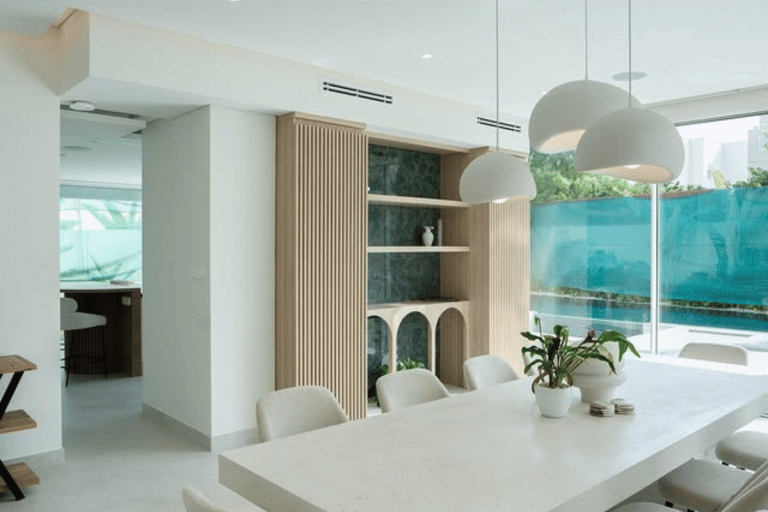
The fluted timber shelving unit occupies the back wall of the dining area and does a significant amount of work. The vertical reeded panels create a strong vertical rhythm that draws the eye upward and gives the wall presence without the use of heavy colour or pattern. The charcoal backdrop behind the open shelves introduces depth and contrast, preventing the unit from reading as a flat surface.
The arched cutouts at the base are subtle but meaningful. They soften what would otherwise be a purely linear composition and introduce a classical reference that grounds the unit in craft tradition. This is a good example of how luxury interior design in Dubai at its best draws on a wide vocabulary rather than defaulting to a single aesthetic mode.
Bespoke joinery of this kind cannot be specified from a catalogue. It is designed, drawn, and built for a specific room, at a specific scale, for a specific family. That is precisely what makes it feel like it belongs.
Material Relationships in the Dining Area
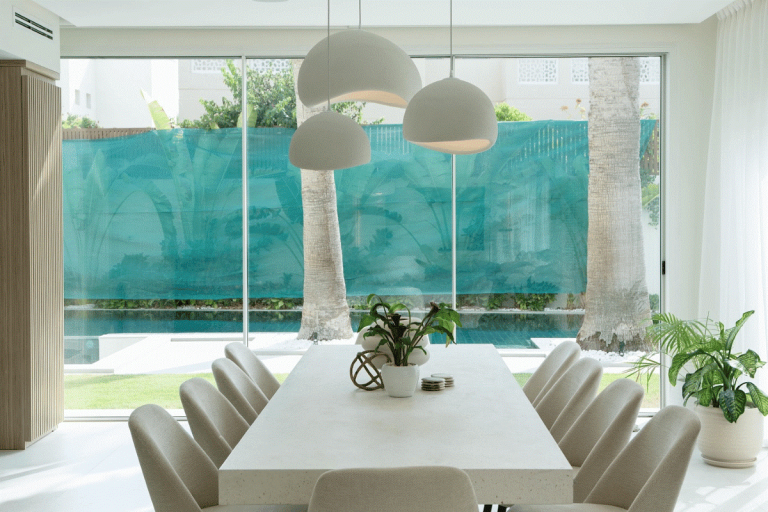
The terrazzo dining table, the dome pendants, and the upholstered chairs all share a light, neutral tone that keeps the room feeling spacious and open. The floor-to-ceiling glazing on the side wall adds to this by flooding the interior with natural light and visually extending the room into the garden.
Setting a warm, textured timber unit against a light, smooth table surface is a deliberate contrast strategy. Each material makes the other more legible. The timber reads as warmer because the terrazzo is cool. The table reads as cleaner because the joinery is textured. This kind of material pairing is central to how we approach every residential project at Wonderwall.
Small-scale objects, the white ceramic vessels, the planted pots, the brass sphere, are placed on the shelves and table with the same care as the larger elements. Styling in a luxury interior is not decoration added after the fact. It is part of the spatial composition from the outset.
The Corridor: A Considered Sequence
The corridor at Meadows 2 runs the full depth of the home and opens at the far end to a landscaped garden view. That view was a known asset from the earliest stages of the project, and we designed the corridor specifically to use it.
The large-format pale tile flooring creates a continuous, unbroken surface that accelerates perspective and draws the eye toward the garden. The cove lighting along the ceiling soffit adds a warm overhead glow that makes the space feel generous rather than constricted. And the full-height fluted timber slat wall on one side introduces texture and warmth without making the corridor feel narrow.
This is luxury interior design in Dubai working at the level of sequence rather than object. The corridor is not just a place to pass through. It is the first full experience of the home’s material language, and it sets expectations that the rest of the house then fulfils.
Why Material Continuity Matters
The fluted detail that appears in the dining area joinery also appears in the corridor wall panelling. This was not accidental repetition. It was a deliberate decision to create a thread of recognition that runs through the home.
When a home uses the same design language across multiple spaces, it reads as considered rather than assembled. Each room feels like it belongs to the same story. In a villa of this scale, that kind of coherence does not happen by default. It requires early decisions about what the repeating elements will be, and discipline in applying them consistently.
At Wonderwall, establishing that design language is one of the first things we do with a client. The Meadows 2 project shows what becomes possible when that language is carried through from concept to completion.
The Role of Lighting in Both Spaces
Lighting decisions were made differently for each space based on function and scale. In the dining area, the three dome pendants are large enough to anchor the ceiling and create a warm focal point above the table. In the corridor, the hidden cove lighting performs the opposite task: it illuminates without revealing a source, producing ambient light that feels inherent to the space rather than applied to it.
These are two fundamentally different lighting strategies, and both are correct for their context. Good residential lighting design means understanding what each space needs, not applying a uniform approach across the whole home.
What Meadows 2 Teaches Us About Residential Design
This project reinforces something we believe deeply at Wonderwall: the quality of a home is determined not by the cost of its materials but by the quality of the thinking that connects them. The dining area and corridor at Meadows 2 are composed spaces where every decision supports the next. That is what distinguishes work that lasts from work that photographs well but disappoints in person.
If you are looking for a design partner to bring this level of rigour to your home in Dubai, we would welcome the conversation. Get in touch with the Wonderwall team to discuss what your project needs.
Frequently Asked Questions
Q: What is the difference between interior design and interior styling?
Interior design encompasses the full spatial and material strategy of a room, including layout, architecture, lighting, joinery, finishes, and furniture selection. Interior styling refers to the placement of objects, art, and accessories within a designed space. At Wonderwall, we treat styling as part of the design process rather than a separate afterthought, which is why the tabletop objects and shelving arrangements at Meadows 2 feel intentional rather than incidental.
Q: How do I know if bespoke joinery is worth the investment for my home?
Bespoke joinery makes the most impact in rooms where proportion and specificity matter most, typically dining rooms, living rooms, and primary bedrooms. Off-the-shelf units are designed to fit a range of rooms, which means they rarely fit any room perfectly. A custom piece, designed for your specific wall at your specific scale, will always read as more considered. It also allows you to specify materials, finishes, and details that align with the rest of your home’s design language.
Q: How does Wonderwall approach colour in a luxury home?
We tend to start with a restrained palette and introduce contrast through material texture rather than colour variation. At Meadows 2, the palette is largely neutral, but the space reads as rich because of the interplay between matte and reflective surfaces, warm timber and cool stone, textured joinery and smooth upholstery. Colour is introduced through plants, ceramics, and art, which can be changed over time without affecting the architectural integrity of the space.
Q: Does Wonderwall work on Meadows and Emirates Living community villas?
Yes. We have extensive experience working with villas across Dubai’s established communities, including Meadows, Springs, Lakes, Arabian Ranches, and beyond. Each community has its own architectural character and planning considerations, and our team is experienced in navigating both the design and authority coordination requirements specific to these areas.
Q: What should I prepare before my first meeting with a Wonderwall designer?
It helps to have a general sense of how you use your home day to day, which rooms feel like they are not working, and any images or references that appeal to you visually. You do not need a fully formed brief. Our job is to develop that with you through the early stages of the process. What matters most in a first conversation is that we understand your household, your priorities, and your timeline.